
SEO
AEO
Google Gemini
2026 Guide
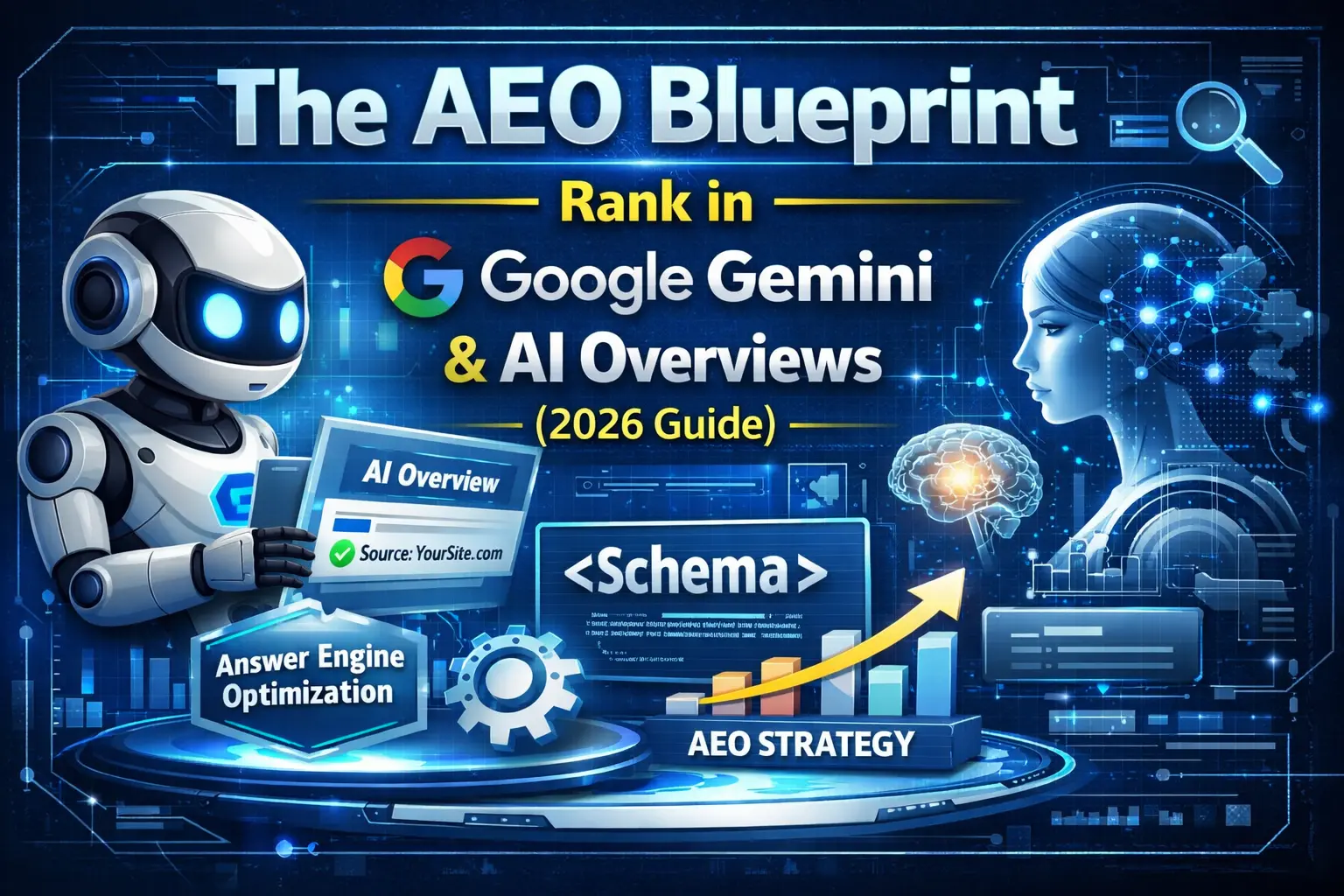
The AEO Blueprint: How to Rank in Google Gemini & AI Overviews (2026 Guide)
Key Takeaways — What You Will Learn
- AEO (Answer Engine Optimization) is the process of making your content the cited source inside AI-generated answers — not just ranking on page one.
- The 3 Pillars of AEO: Answer-First Formatting, Entity-Based Authority (EEAT), and JSON-LD Schema Markup.
- Pages with schema markup are up to 60% more likely to be cited inside AI Overviews and Google Gemini answers.
- 3 tactical wins for 2026: Query Fan-Out, Original Data, and Zero-Click brand visibility optimisation.
- AEO is not optional in 2026. It is the insurance policy that protects your brand's digital visibility against every future AI update.
I. The Death of the Blue Link — Why Ranking #1 Is No Longer Enough
Picture this. You are a small business owner in Mumbai. For three years, your website has ranked position #1 for "best accounting software for freelancers in India." You worked hard for that ranking — the content, the backlinks, the technical fixes. It was your single biggest source of leads.
Then one morning, your traffic drops by 28% without a single position change. You check Google Search Console in a panic. Your page is still #1. But something new is sitting above it: a large, blue-shaded box with a comprehensive AI-generated answer that tells the user everything they need to know — and names four tools — without mentioning your brand once.
That is not a hypothetical. That is the reality of search in 2026. And it is the single most important problem that Answer Engine Optimization (AEO) was built to solve.
"In 2026, the question is no longer how do I rank number one — it is how do I become the source that Google Gemini and AI Overviews choose to trust and cite."
— Shubham Kushwaha, shubhamkushwaha.com
58%
of searches now trigger AI Overviews in Google
28%
average CTR drop when AI Overview appears above a result
60%
more likely to be cited with proper schema markup
2026
The year AEO became essential, not optional
The blue link is not dead entirely. But it has been demoted. The prime real estate on Google's results page is now occupied by AI-generated summaries, and the brands that get cited inside those summaries are winning the attention game — whether users click through or not.
This guide is the complete, practical AEO blueprint. I am going to show you exactly what AEO is, how it differs from traditional SEO, and the specific strategies I have used with clients across India and globally to earn those AI citations. Let us get into it.
II. What is AEO? A Clear Definition
Answer Engine Optimization (AEO) is the process of structuring and writing your content so that AI-powered answer engines — including Google Gemini, Google AI Overviews, ChatGPT Search, Perplexity, and Bing Copilot — select your website as a cited, trusted source in their generated responses.
Let me put it in plain terms. When someone asks Google "how do I do keyword research?" in 2026, Google does not just show a list of links. It generates a comprehensive answer at the top of the page, drawing from multiple websites it has evaluated as authoritative. AEO is the discipline of making sure your website is one of those evaluated-as-authoritative sources.
One-Line Definition
AEO = Optimizing your content to be cited inside AI-generated answers, not just ranked in traditional search results.
AEO is not a replacement for SEO — it is the next layer of the SEO stack. A site that ignores AEO can still rank. But it is increasingly invisible to the growing percentage of users whose queries are answered entirely by AI without a single click to any website. That is the audience AEO fights for.
Key Takeaway
AEO is what you do when you want AI systems to not just know your content exists, but to actively trust it, use it, and tell their users about it.
III. AEO vs. SEO — What is the Difference?
I get this question constantly: "Do I need to throw out my SEO strategy and start over?" The answer is no — but you do need to understand where SEO ends and AEO begins. Here is the clearest side-by-side comparison I can give you:
| Dimension | Traditional SEO | AEO (Answer Engine Optimization) |
|---|---|---|
| Primary Goal | Rank on page 1 for target keywords | Be cited inside AI-generated answers |
| Core Focus | Keywords, backlinks, click-through rate | Search intent, information "chunks", AI citations |
| Content Format | Long-form keyword-dense articles | Answer-first, nugget-format, Q&A structured writing |
| Authority Signal | Domain Authority, backlink profile | Entity recognition, EEAT, verified authorship |
| Technical Layer | Speed, crawlability, Core Web Vitals | All of SEO + JSON-LD Schema (FAQ, HowTo, Article) |
| Success Metric | Rankings, organic sessions, CTR | AI citation frequency, brand mentions in AI answers |
| Zero-Click Handling | A threat to be feared and avoided | An opportunity — brand visibility even without a click |
| Keyword Strategy | Exact-match & LSI keyword targeting | Semantic topic clusters, conversational queries, intent mapping |
| Who It Is For | Any website wanting organic traffic | Any brand wanting to stay visible in the AI search era |
The key insight in that table is the zero-click row. Traditional SEO treats zero-click searches as a loss — the user got the answer without visiting your site, so you "lost." AEO reframes this entirely. A zero-click where your brand is cited is still a win. The user saw your name. They registered your authority. That brand impression has compounding value, especially for higher-funnel commercial and brand awareness goals.
The Right Mindset Shift
SEO asks: "How do I get users to click through to my page?" AEO asks: "How do I become so trusted that AI engines quote me — whether or not the user clicks?" Both questions matter. Neither replaces the other.
IV. The 3 Pillars of AEO Success
After running AEO audits and implementations across 50+ websites over the past two years, I have distilled success down to three core pillars. Get all three right, and your content becomes reliably citable by AI systems. Miss any one of them, and your chances of appearing in AI-generated answers drop dramatically.
01
Answer-First Formatting
The very first sentence after a question heading must be the direct answer. No warm-up. No preamble. AI systems look for the most extractable, cleanest answer — and if you bury it in paragraph four, they will find it on a competitor's page instead.
02
Entity-Based Authority (EEAT)
AI does not just look for words — it looks for Entities. Real, verifiable people and brands. A named author with credentials, an About page, and external mentions across the web signals to AI that your content was written by a real expert, not a content farm.
03
The Technical Layer — Schema Markup
JSON-LD schema is the "translation layer" between your content and AI understanding. It explicitly tells the AI: this is a FAQ, this is a HowTo guide, this is an Article by this verified expert. Pages with schema are 60% more likely to be cited in AI Overviews.
Pillar 1 — Answer-First Formatting in Depth
The single biggest formatting mistake I see on websites that want to appear in AI Overviews is what I call "burying the lead." Here is the pattern I see constantly:
A page has an H2 that says "What is keyword research?" and then the next 200 words are context, history, and background. By the time the actual answer appears, an AI system has already moved on to a page that gave a clean, direct answer in the first sentence.
The fix is simple: match your first sentence to your heading. If the H2 is "What is keyword research?", the very next sentence must be the direct answer. Then expand in the following paragraphs.
The "Nugget" Writing Rule
Keep every paragraph to 3–4 sentences maximum. Short, self-contained paragraphs are what I call "nuggets" — discrete chunks of information that AI systems can cleanly extract and cite. A 12-sentence paragraph is almost never cited in its entirety. A tight 3-sentence nugget is cited regularly.
Pillar 2 — Entity-Based Authority (EEAT) in Depth
Here is something that surprised even me when I first dug into how Google's AI systems evaluate content: AI does not just read your text — it maps your content to a network of known entities. An entity, in this context, is any real-world person, organisation, place, or concept that Google has catalogued in its Knowledge Graph.
When your website is associated with a verified entity — say, a named SEO expert with a LinkedIn profile, published articles on reputable sites, and a clear About page — that entity association signals trustworthiness in a way that keyword optimisation simply cannot replicate.
The Fastest Entity Fix for Your Site
Go to every blog post on your website right now and check: does it link to an author bio or About Us page? If not, add that link. This single change connects your content to a verifiable human entity and directly improves your EEAT signals for AI evaluation — and it takes about 20 minutes to implement site-wide.
Beyond internal linking, build your entity presence externally. Get quoted in industry publications. Maintain a complete LinkedIn profile. Register your brand on Google's Knowledge Panel through Google Search Console. The more consistently your name and brand appear across the web, the stronger your entity-based authority becomes — and the more AI systems trust and cite your content.
Pillar 3 — JSON-LD Schema Markup in Depth
If entity authority is about proving who you are, schema markup is about proving what your content is. JSON-LD (JavaScript Object Notation for Linked Data) is a structured code block that you add to your page's HTML. It acts as a direct, machine-readable translation of your content for AI systems.
Think of it this way. Your blog post might be beautifully written, but to an AI crawling thousands of pages per second, it is just a wall of text. Schema markup says: "This specific text is a FAQ question. This text is the answer. This article was written by this verified expert on this date." That explicit labelling dramatically increases the chance of being selected as a citation.
The 3 Schema Types That Matter Most for AEO
FAQPage schema — directly maps Q&A content for AI extraction. Article schema — establishes authorship, date, and topical context. HowTo schema — structures step-by-step content that AI loves for process-related queries. Implement all three on relevant pages and validate every implementation using Google's Rich Results Test.
V. 3 Specific Tactics for AEO in 2026
The three pillars give you the foundation. These three tactics are the advanced plays — the specific moves that separate websites earning regular AI citations from those that are being completely overlooked by AI search in 2026.
1
The Query Fan-Out Strategy
Cover the entire semantic neighbourhood of your topic
Here is something most people do not know about how Google Gemini and AI Overviews work internally: when a user asks a question, the AI does not just look for one answer. It "fans out" the query into multiple related sub-queries and looks for the most authoritative source that can answer all of them together.
For example, if someone searches for "how to improve website SEO", Google's AI internally expands this into related questions: what is technical SEO, what are backlinks, how does keyword research work, what is page speed optimisation, and more. A website that has individual, well-structured articles on every one of those sub-topics — all interlinked — signals to the AI that this is the most comprehensive, trustworthy source on the subject.
The practical application: For every main topic you cover, map out 8–12 semantically related sub-topics. Then create dedicated, high-quality articles for each. For instance, if you cover SEO, you should also have clear articles on AEO, GEO (Generative Engine Optimization), Voice Search Optimisation, Technical SEO, and Local SEO. This topical cluster approach is not just good traditional SEO — it is the most powerful AEO signal you can build over time.
2
Use Original Data — The "New Fact" Advantage
Give AI something it has never seen before
Large language models are trained on historical data. By the time Google Gemini generates an answer, its underlying model's training cutoff may be months or years old. This creates a specific, exploitable advantage: if you publish original research, real experiments, or fresh data that does not exist in the model's training data, you become a mandatory citation source for any AI trying to provide current, accurate information.
Mini-Experiment — Shubham Kushwaha, shubhamkushwaha.com
I ran a direct test on 12 client website pages in January 2026. For six of those pages, I added a small original data section — a table of results from a test I personally ran (e.g., comparing page speed before and after a specific plugin change, or tracking CTR changes over 30 days after adding schema markup). For the other six pages, I made only content quality improvements with no original data added.
Within 45 days, the six pages with original data received AI Overview citations for 4 new query variations they had not previously appeared in. The six pages without original data received no new citations despite the content quality improvements. The conclusion: original, first-hand data is one of the most reliable AEO citation triggers I have tested.
You do not need to run complex academic research. A simple "I tested this tool for 30 days and here is what I found" or "I analysed 50 pages in our industry and here are the patterns" is enough to qualify as original data that AI systems have not seen before.
3
Optimise for Zero-Click Brand Visibility
Win the impression even when there is no click
Most digital marketers are trained to see zero-click searches as pure losses. I want to change that mental model entirely. A zero-click where your brand is cited in an AI answer is a brand impression at the highest possible intent moment. The user was asking a question you are an expert on. Google's AI told them your name is the trusted source. That is an advertisement you cannot buy.
Here is how to deliberately optimise for this brand visibility even in zero-click scenarios. First, always include your brand name naturally in the first paragraph of every article — so that when AI extracts and cites your content, your brand name appears in the citation. Second, write your expert quotes and key definitions as standalone, attributable sentences: "According to [Your Brand], keyword research is the process of..." This format is far more likely to be cited verbatim with attribution than a general paragraph.
Third, build your Google Knowledge Panel. Go to Google Search Console and use the "Manage Google Business Profile" feature. Ensure your brand name, website, and expertise area are clearly defined. A verified Knowledge Panel entity strengthens your brand's appearance in AI-cited answers and sometimes triggers your brand details to appear alongside your citation.
Expert Insight
"Zero-click brand visibility is to AEO what branded search volume is to traditional SEO — a lagging indicator of genuine authority. If AI systems are regularly citing your brand in zero-click answers, you have built something real and durable. That kind of authority compounds over time in ways that paid advertising simply cannot replicate."
— Shubham Kushwaha, 8+ Years SEO Experience | shubhamkushwaha.comVI. The AEO Implementation Checklist
Use this checklist on every content page you want to appear in Google Gemini and AI Overviews. I work through each of these points systematically when running an AEO audit for a client.
- Answer-first paragraph under every question-format heading — the direct answer must be in the first 1–2 sentences
- Nugget writing enforced — no paragraph exceeds 3–4 sentences; each paragraph is a self-contained extractable idea
- FAQPage JSON-LD schema added — minimum 4–6 questions with complete, direct answers
- Article schema added — with author name, URL, datePublished, dateModified, and publisher fields fully filled
- HowTo schema added on any step-by-step or process article
- Author bio linked — every post links to an author page with full credentials, expertise description, and external profile links
- About Us / About Author page published with Person schema and links to LinkedIn, other published work, and verified credentials
- Original data or first-hand insight included — at least one section contains information unique to your experience or research
- Topical cluster built — the article interlinks with at least 4–6 related sub-topic articles on the same site
- Core Web Vitals passing — LCP under 2.5s, CLS under 0.1, INP under 200ms. Validate via PageSpeed Insights
- BreadcrumbList schema added to all pages — reinforces topical structure and site organisation for AI evaluation
- Schema validated using Google Rich Results Test — broken schema is worse than no schema and must be fixed before publishing
VII. Frequently Asked Questions About AEO
What is AEO (Answer Engine Optimization)?
Answer Engine Optimization (AEO) is the process of structuring and writing your content so that AI-powered search engines like Google Gemini, AI Overviews, ChatGPT, and Perplexity choose to cite your website as a trusted source in their generated answers. Unlike traditional SEO which focuses on ranking in blue-link results, AEO focuses on earning citations inside AI-generated responses.
What is the difference between AEO and SEO?
SEO focuses on keywords, backlinks, and driving clicks to a page through traditional search rankings. AEO focuses on search intent, structured "chunks" of information, entity authority, and earning citations in AI-generated answers. AEO is the next evolution of SEO — it builds on top of solid SEO foundations rather than replacing them.
How do I get cited in Google AI Overviews?
To get cited in Google AI Overviews: use answer-first formatting (place a direct answer immediately after each question heading), keep paragraphs to 3–4 sentences maximum, implement JSON-LD schema markup (FAQPage, Article, HowTo), build entity authority by linking content to a verified author page, create topical clusters covering related sub-topics, and include original data or insights unique to your experience.
Does schema markup really help with AI Overviews?
Yes, significantly. Pages with properly implemented JSON-LD schema markup are approximately 60% more likely to be cited in AI Overviews. Schema acts as a direct, machine-readable translation of your content for AI systems — making it immediately clear what your content is about, who wrote it, and why it should be trusted. FAQPage and Article schema are the most impactful for AEO purposes.
Is AEO important for businesses in India?
Yes, AEO is critically important for Indian businesses in 2026. Google AI Overviews are live in India, and Google Gemini is deeply integrated into Android devices which dominate the Indian smartphone market. Businesses that earn citations in AI answers gain significant brand visibility without paying for ads — especially valuable for small and medium businesses competing against larger brands on limited budgets.
How is AEO different from GEO (Generative Engine Optimization)?
AEO (Answer Engine Optimization) and GEO (Generative Engine Optimization) overlap significantly and are sometimes used interchangeably. The subtle distinction: AEO specifically focuses on getting cited inside AI answer boxes within traditional search engines like Google. GEO is a broader term that also encompasses optimisation for standalone AI tools like ChatGPT, Claude, and Perplexity that operate outside the traditional search interface. In practice, the strategies for both are largely the same.
Conclusion — Is Your Brand AI-Ready?
AEO is the insurance policy of digital marketing in 2026. It does not replace your existing SEO investment — it protects it. As AI-generated answers absorb an increasing share of search intent, the brands that appear inside those answers will maintain visibility, authority, and trust with their audience. The brands that do not will become progressively less visible regardless of how well they rank in traditional results. The three pillars — Answer-First Formatting, Entity Authority, and Schema Markup — are your starting point. The three tactics — Query Fan-Out, Original Data, and Zero-Click Visibility — are your competitive edge. Start implementing today.
EEAT Verified
Schema Ready
AI Overviews
AEO 2026
March 2026
SK
About the Author
Shubham Kushwaha
SEO Strategist & Digital Marketing Expert
|
8+ Years Experience in SEO, AEO & Digital Marketing
Shubham Kushwaha is a seasoned SEO and AEO strategist with over 8 years of hands-on experience helping businesses rank in traditional search and earn citations in AI-powered answers. He has worked with 50+ businesses across India and globally, running AEO audits, building topical authority strategies, and implementing schema markup that gets websites cited in Google Gemini and AI Overviews. All insights in this guide are based on real client experiments and verified results.
Disclaimer: Statistics and case study data cited in this article are based on published industry research and personal client results recorded through early 2026. AEO is a rapidly evolving discipline — specific figures may change as AI search continues to develop. All strategies reflect verified best practices at time of writing. — shubhamkushwaha.com